
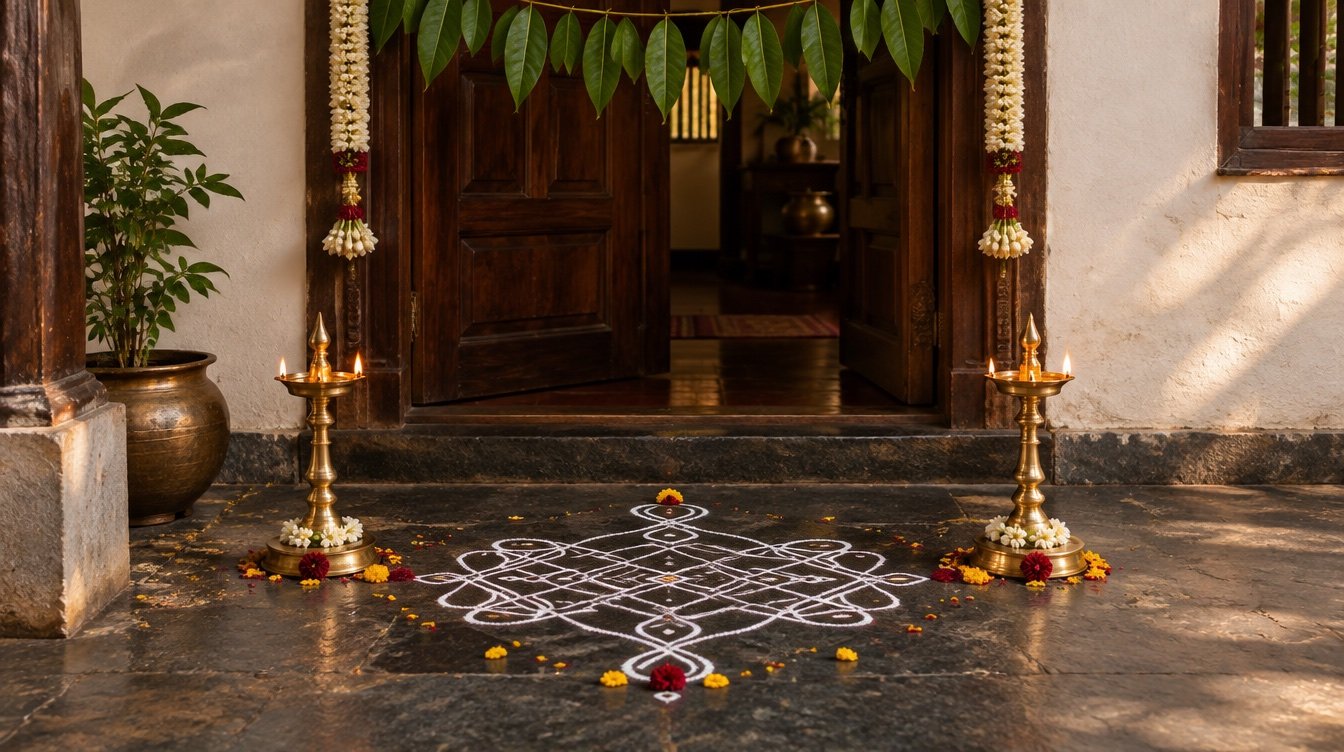
What the ceremony is for
A house becomes a home when the family formally takes it into use, and Griha Pravesham is the observance that marks that moment. The word means, simply, entering the house. In practice the ceremony does three things at once: it purifies the space, it invites the family's deities and the presiding spirit of the site to be present in it, and it puts the house to use for the first time through a set of small, deliberate acts, of which cooking the first meal is the most important.
Families in Chennai write the name several ways, and all of them refer to the same ceremony. You will see Griha Pravesham, Gruhapravesam, Gruhapravesham and the north Indian form Griha Pravesh. Housewarming pooja is the everyday English for it.
Three kinds of house entry
Traditional texts do not treat every house entry the same way, and priests still work from the distinction when planning what to perform. It is worth knowing which category yours falls into before you speak to an Iyer, because it is the first thing you will be asked.
- Entering a newly built or newly bought house for the first time. This is the fullest form of the ceremony, and the one most people picture when they think of Griha Pravesham.
- Returning to a house after a long absence. A shorter observance, performed when a family comes back to a home they had left standing for an extended period.
- Re-entering after major repair or reconstruction. Performed when significant structural work has been done, or after an event that the family considers has disturbed the house.
The distinction matters practically. A family moving into a resale flat often assumes they need the full ceremony, and a family moving back into a renovated house often assumes they need nothing. Both are worth checking rather than guessing.
Choosing the date
The date is not chosen for convenience. A priest reads the panchangam for the day's tithi, nakshatram and lagnam, and weighs those against the nakshatram of the head of the household. Most ceremonies are timed for the morning and finish before Rahu Kalam, which is why Griha Pravesham invitations so often give a narrow window rather than a start time.
Beyond the panchangam, families follow their own conventions about which Tamil months are suitable for functions of this kind, and these vary from family to family. This is exactly the sort of thing where asking an elder in the family is more reliable than a general calendar online.
Two practical points. First, auspicious dates cluster: in a given month there may be only a handful, and within those only a couple of good morning windows. Second, every family in the city is working from the same panchangam, so those windows are booked early and well-regarded priests go first.
If your move-in depends on a builder handover, treat the muhurtham as the fixed point and the handover as the variable, not the other way round. Families who book the priest after the handover confirms routinely end up with a worse date.
More on how the muhurtham is fixed
The week before
Most of the stress of a Griha Pravesham is logistical rather than ritual, and almost all of it can be handled in the week before.
- Confirm the sequence with your Iyer. Ask specifically whether a homam is included, whether Vastu rituals are part of the day, and whether you are doing a Satyanarayana Pooja afterwards. These three choices determine the duration and roughly half the shopping list.
- Get the kitchen working. The gas connection, or at least a working stove, needs to be live on the morning. This is the single most common last-minute failure, because it depends on an external agency rather than on you.
- Clean the house properly and keep it that way. The ceremony assumes a clean, empty, unused space. Moving furniture in before the ceremony defeats the point, so plan the movers for afterwards.
- Buy the perishables late, the rest early. Flowers, mango leaves, plantain trees, fruit and milk on the morning or the evening before. Everything else can be bought a week ahead.
- Sort out the homam space. If you are in an apartment, check with the association and pick a room with genuine ventilation, or move it to a balcony.
- Tell the Iyer the headcount. The number of people affects the space arrangement and sometimes the quantities.
The sequence on the day
What follows is the sequence most commonly observed in Chennai. Your ceremony may include more or fewer of these, in a somewhat different order, depending on what your family observes and what your priest advises.
- Ganapathi Pooja. Performed first, so the rest of the day proceeds without obstruction.
- Punyahavachanam. The purification of the space and of the materials that will be used.
- Vastu rituals. Addressed to the presiding spirit of the site and the structure. Some families include a Vastu Homam at this point.
- Kalasha sthapanam. The sacred pot is prepared, filled and established, and the family carries it in.
- Navagraha rituals. Where the family observes them, or where the priest advises them for the chosen day.
- The entry. At the muhurtham moment the family crosses the threshold, customarily right foot first, carrying the kalasam and accompanied by the traditional sounds of the household.
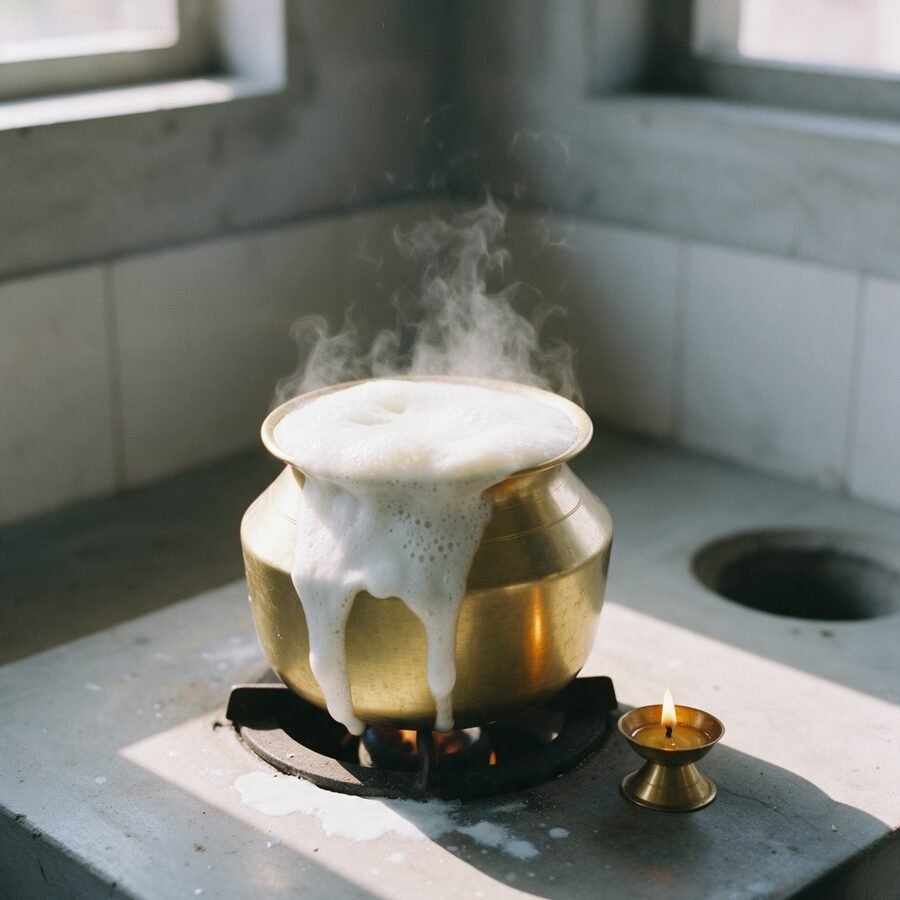
- Paal kaachal. Milk is boiled in a new vessel until it rises and overflows.
- Homam. Where the family has chosen to include one.
- Satyanarayana Pooja. Performed by many families on the same day, or within the days that follow.
The milk boiling
Of everything that happens, the milk boiling is the part families remember, and it is worth understanding rather than just executing. Milk is set to boil in a new vessel on the new stove, and it is deliberately allowed to rise and spill over. The overflow is the point: it stands for abundance in the house, and it is the first real use of the kitchen.
Two practical notes that nobody mentions until the morning. Use a vessel wide enough that the overflow runs down the sides rather than shooting across the room, and have someone watching it, because everyone else will be occupied with the pooja at precisely the moment it rises.
After the ceremony
The lamp is customarily kept lit through the day, and many families cook and eat the first meal in the new house immediately after the ceremony rather than ordering in. Some families observe a practice of not leaving the house empty for a set number of days afterwards. Ask your Iyer what your family's tradition expects, since this is one of the areas where practice differs most.
The furniture, the movers and the unpacking all come after. It is tempting to compress the move into the same day, and it almost always makes the ceremony worse.
Almost everything that goes wrong on the day is logistical, not ritual.
What usually goes wrong
Across the ceremonies we help arrange, the same handful of problems recur, and none of them are ritual problems.
- The gas connection is not live on the morning, so the milk boiling has to improvise.
- The priest is booked late and the family settles for a weaker date.
- Nobody checked whether the apartment association permits a homam.
- Furniture and cartons are already in the house, so there is no clean space to set up.
- The family does not know how long the ceremony will run, and guests arrive at the wrong time.
- Flowers and mango leaves are bought two days early and are unusable by the morning.
All six are avoidable with one conversation a week in advance, which is the main argument for talking to your priest early rather than confirming a date and going quiet.
Keep reading